Best suited to
Industrial and commercial projects requiring a true mechanically polished finish.
Concrete polishing / System
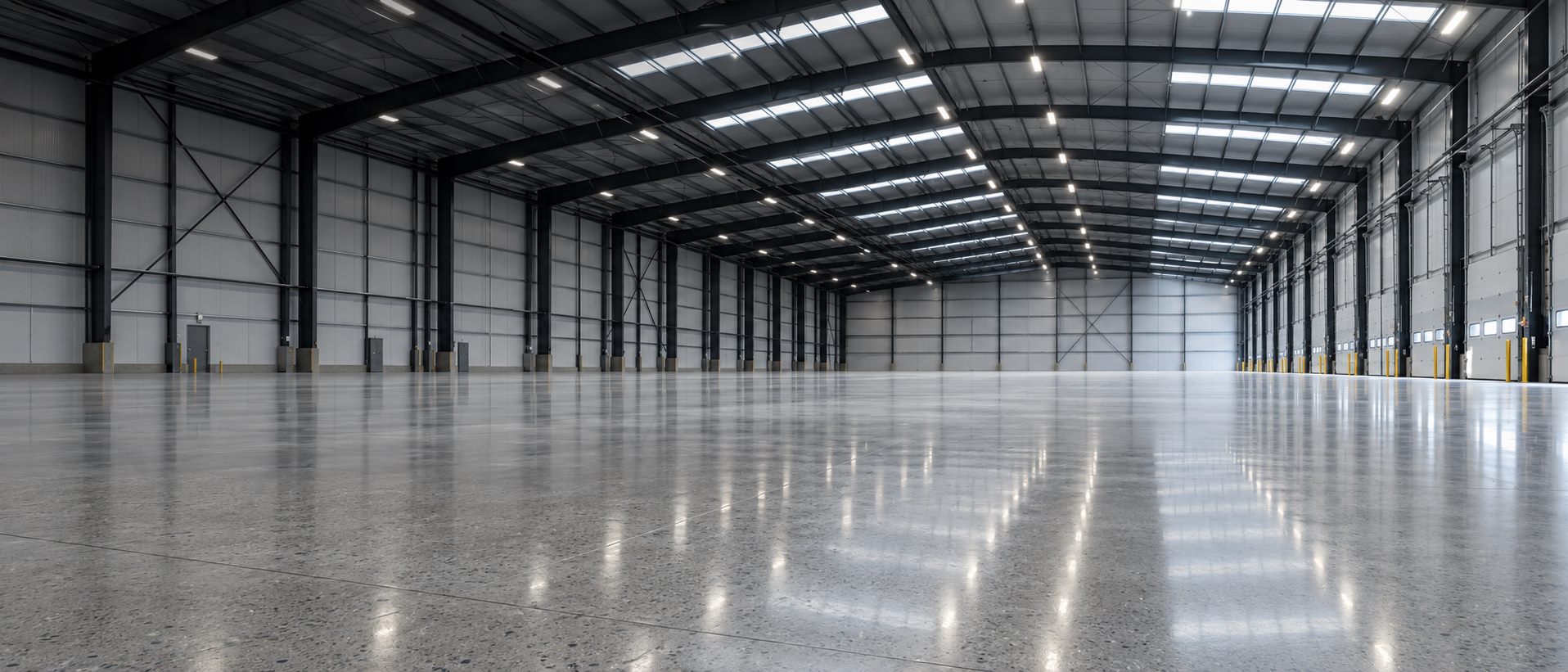
Progressive diamond tooling transforms a structural slab into a durable, light-reflective finished surface.
The right system
Diamond polishing progressively refines a suitable concrete surface with abrasive tooling. The chosen starting cut influences how much sand or aggregate is exposed; later refinement influences clarity and sheen.
A high sheen does not necessarily require deep aggregate exposure. Ask for a sample showing the proposed cut, densification and protection, including what will happen at edges and in areas with different slab hardness.
Industrial and commercial projects requiring a true mechanically polished finish.
A refined surface whose finish is created within the concrete rather than by a film coating.
long-life, high-performance floors.
Technical overview
Diamond polished concrete is produced by successive mechanical passes using metal-bond and resin-bond diamond tooling. Each stage removes scratches from the previous pass until the agreed surface refinement and reflectivity are achieved.
the brief requires a true mechanically polished surface rather than a topical gloss coating.
tooling sequence, target exposure, densifier compatibility, final grit, guard treatment and slip considerations.
Aggregate exposure and sheen are separate choices. A mock-up should show likely tonal variation, repairs and edge treatment.
Use neutral cleaning chemistry, suitable auto-scrubber pads and prompt spill removal. Periodic burnishing or guard renewal depends on traffic and the specified finish.
A lower-refinement industrial finish can reduce processing where appearance is secondary to performance.
Specification framework
Record strength, flatness, cracks, joints, historic coatings, contamination and repairs before selecting the cut.
Agree aggregate exposure and sheen separately, with a representative trial including edges and repaired areas.
Describe wheeled and pedestrian traffic, spill exposure, slip considerations and required cleaning methods.
Allow for dust management, phased access, sample approval, protection and handover cleaning.
Delivery method
Condition, flatness, contamination, repairs, access and programme constraints are recorded.
Appearance, performance and realistic slab variation are agreed before full installation.
Our specialist team manages preparation, finishing, protection and handover.
Specification questions
Not necessarily. Aggregate exposure is set mainly by the depth of the initial cut; sheen is developed during subsequent refinement.
No. Densifiers and protective treatments can improve cleanability, but concrete remains a porous material. Spill response and maintenance still matter.
Use the cleaning method and chemistry agreed for the finish; avoid aggressive products and abrasive pads that can damage protection or reduce sheen.
Start a conversation
Send the location, approximate area, construction stage, intended use and programme. Include plans or photographs if available; we can then discuss the most suitable next step.